
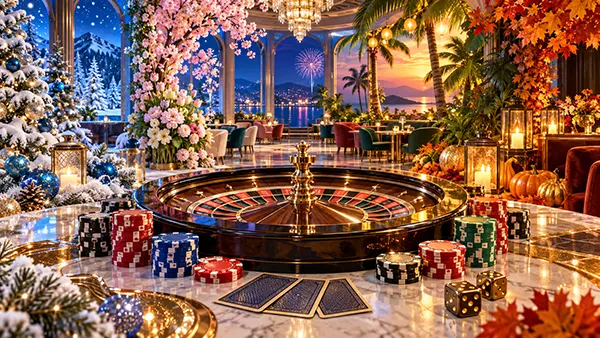
How Online Casino Play Changes During Major Holidays and Seasonal Events
Major holidays and seasonal events do not alter the basic mathematics of online casino games, but they can noticeably change the way casinos organise their game selections, promotions and player-facing content. Christmas and New Year are the clearest examples, although Halloween, Easter, Valentine’s Day and summer periods can also influence what appears in casino lobbies. During these periods, established games may receive temporary visual treatments, new themed slots can move into prominent positions, tournaments and prize campaigns become more visible, and promotional deadlines may become shorter. The result is a casino experience that can look and feel quite different for several days or weeks without necessarily changing the underlying rules of the games themselves. By 2026, seasonal activity has also become more closely shaped by responsible gambling requirements and clearer promotional rules in regulated markets, meaning that players need to look beyond festive graphics and check exactly what an offer, tournament or temporary feature involves.
Why Online Casinos Look Different During Holiday Periods
The first noticeable change during a major holiday is usually the casino lobby. Operators routinely reorganise game categories around current events, moving Christmas slots towards the front of the site in December, horror-themed titles into more visible positions before Halloween and summer or travel-themed games into seasonal collections during warmer months. This does not normally mean that the standard catalogue disappears. Roulette, blackjack, baccarat, classic slots and live casino games usually remain available, while temporary categories are added alongside them. Seasonal organisation is mainly intended to make timely content easier to find. Two players visiting the same casino several months apart may therefore see many of the same games but encounter them in a different order, surrounded by different banners, categories and featured titles.
Game developers also plan releases around periods when certain themes are especially relevant. Christmas has become a particularly established part of the annual release calendar. Play’n GO, for example, maintains a dedicated Christmas collection that includes titles such as Boat Bonanza Christmas and Xmas Joker, alongside other festive games from its catalogue. Its seasonal presentation has included a Christmas countdown running from 24 November to 25 December, with game trailers, features and other themed material appearing through the period. This shows that seasonal casino content is no longer limited to releasing a single Christmas slot in December. Developers can build a wider collection around an event and give existing titles renewed visibility while adding newer releases to the same group.
Sometimes the seasonal change is mainly cosmetic rather than a new game. Relax Gaming lists 9K Yeti Gold Dream Drop with an automatic Santa-themed appearance that activates in December and is removed in January. The underlying title remains recognisable, but its presentation changes for the festive period. This distinction is important for players because a new visual design should not be assumed to mean new odds, a different return percentage or a more favourable chance of winning. When an existing game receives a seasonal skin, the safest approach is to check the information panel rather than judge it by its temporary appearance. If a separate Christmas edition has been released as an individual game, its rules, volatility, maximum win and return-to-player figure may differ and should be assessed independently.
Seasonal Games, Temporary Features and Changing Game Choices
Seasonal releases tend to use immediately recognisable imagery because the theme needs to make sense during a relatively short period. Christmas games commonly use snow, presents, decorated trees, winter settings and Santa characters, while autumn releases often favour darker settings, supernatural characters and horror imagery. The theme itself does not determine how a slot works. A festive game may use conventional paylines, clusters, Megaways-style layouts, hold-and-spin rounds, free spins or collection mechanics just as a non-seasonal title would. For this reason, choosing a game because it fits the time of year is a matter of preference rather than a strategy for improving results. Two Christmas slots can have completely different volatility profiles and bonus structures despite sharing almost identical seasonal imagery.
Temporary promotional layers can also make familiar games feel different even when the individual game rules remain unchanged. In August 2026, Pragmatic Play introduced Collect & Win as part of its promotional tools, allowing operators to customise themes and collection elements across supported slot and live casino titles. Features of this kind can be adapted to particular campaigns, giving players additional objectives such as gathering specified symbols or completing collections. Similar concepts are frequently used for tournaments, prize drops and timed events. The important difference is that these mechanisms normally sit around the casino session rather than rewriting the mathematical rules of every participating game. Players should therefore distinguish between the game’s own paytable and a separate promotional mechanism with its own eligibility conditions.
Seasonal periods can consequently affect which games people choose. A player who usually goes directly to a familiar slot may instead notice a Christmas collection, a Halloween category or a tournament restricted to selected titles. Another player may choose games simply because they contribute towards a temporary campaign. That change in behaviour matters more than the visual theme itself. Joining an event can lead someone to play a title they would not normally select, use a different stake or continue for longer to reach a tournament position or collection target. Seasonal content is therefore best treated as a change in presentation and choice rather than evidence that a particular period offers inherently better winning opportunities.
How Bonuses, Tournaments and Player Activity Change Around Holidays
Promotional schedules often become more concentrated around major calendar events. Instead of one offer remaining available for several weeks, a casino may divide a seasonal campaign into daily rewards, weekend tournaments, limited free-spin offers or short collection events. Advent-style campaigns are especially well suited to December because each day can have a separate reward or activity. New Year promotions may have an even narrower claim period, while Halloween campaigns are commonly centred on the days immediately surrounding 31 October. This makes timing more important than it is with an ordinary ongoing offer. A promotion displayed prominently on Christmas Eve may expire before the end of Boxing Day, so the date on which a player sees an offer is not necessarily a reliable indication of how long it remains usable.
Tournaments can also change the rhythm of play because rewards are determined by competition rules rather than ordinary game outcomes alone. Some casino tournaments award points for wins, others use multipliers, consecutive results, selected bonus events or another published scoring method. The person with the largest monetary win is therefore not automatically the tournament leader. Seasonal competitions may run for a few hours, several days or an entire festive period, and only specified games or stakes may count. Before participating, it is useful to check the scoring method, start and finish times, eligible titles, minimum qualifying stake and number of prize positions. These details determine how the competition works far more directly than its Christmas, Halloween or summer theme.
Holiday periods may also change when and how people play because normal routines are different. Some people have more time away from work, while others spend less time online because of travel or family commitments. Christmas can also coincide with earlier salary payments for some employees, followed by a longer interval before the next payday. GamCare has specifically identified early December paydays and disruption to normal routines as issues that can increase difficulties for people already experiencing gambling harm. These circumstances do not mean that holiday gambling is automatically problematic, but they explain why spending that seems manageable at the beginning of a festive break can have a different effect once January expenses arrive.
What the 2026 Rules Mean for Seasonal Casino Promotions
Players should not assume that every seasonal bonus can be structured in any way an operator chooses. Regulation increasingly determines what licensed casinos can offer. In Great Britain, important changes to the Gambling Commission’s rules took effect on 19 January 2026. Licensed operators can no longer apply wagering requirements above ten times the bonus funds covered by an incentive. For example, a £10 bonus subject to the maximum permitted requirement would involve £100 of wagering on the bonus funds rather than the £500 that a 50-times requirement would have demanded. The change is particularly relevant during promotional periods because wagering requirements have traditionally been one of the most important conditions attached to casino bonuses.
The same British rules also prohibit incentives that require customers to use more than one type of gambling product within a single promotion. Casino, betting, bingo and lottery are treated as separate product types for this purpose. A festive incentive therefore cannot require a British customer to place sports bets and play casino games as combined qualifying activities. The Gambling Commission introduced the restriction because mixed-product offers can add complexity and expose customers to different forms of gambling within one incentive. These requirements apply to licensed British businesses, however, and should not be treated as universal rules for every country. Bonus regulations vary considerably between jurisdictions, making the casino’s licence and the player’s location important.
Advertising rules also affect the way holidays can be used in casino marketing. UK advertising guidance requires gambling promotions to state significant conditions clearly and warns against material likely to have strong appeal to people under 18. The ASA has specifically advised gambling advertisers to exercise caution when using Christmas themes because depictions of Christmas traditions can have strong appeal to younger audiences depending on how they are presented. Consequently, festive marketing at a regulated casino may be more restrained than the seasonal design of the games themselves. A Christmas slot can contain familiar festive imagery, while advertising that uses similar imagery to promote gambling must still comply with separate age-protection and social-responsibility rules.

How to Approach Online Casino Play During Seasonal Events
A major holiday is a useful moment to separate genuine changes from decorative ones. Snow-covered reels, pumpkins, fireworks or summer graphics may make a casino look different, but random game outcomes do not become more favourable simply because a seasonal event has begun. A slot that normally has a specified RTP and volatility does not receive better odds merely because it is promoted in a Christmas category. Likewise, a roulette wheel does not become more likely to produce a particular colour on New Year’s Eve. Where a developer launches a separate seasonal edition, however, it should be treated as a separate title and its own rules should be checked. This simple distinction prevents seasonal presentation from being mistaken for a change in mathematical probability.
Promotional value should also be considered separately from the amount displayed in a banner. A reward of 50 free spins cannot be evaluated properly without knowing the stake per spin, eligible game, expiry period and any wagering conditions attached to resulting bonus funds. A tournament prize pool tells a player how much may be distributed across the competition but says little about an individual participant’s prospects until the number of prizes and scoring rules are known. Seasonal offers can therefore be compared sensibly only through their complete terms. A smaller offer with straightforward conditions may be easier to understand than a larger-looking campaign with several stages, narrow deadlines or restrictions on qualifying games.
Holiday schedules deserve attention as well. Casino games may remain accessible around the clock, but customer support teams, banks and some payment services can operate differently on public holidays. A withdrawal requested immediately before Christmas or New Year may therefore take longer to reach a bank account even when the casino has completed its own processing stage. Exact timings depend on the operator, payment method and banking system, so players should rely on the published withdrawal information rather than assuming that normal working-day estimates will apply throughout a holiday period. This is particularly relevant when money is expected for other expenses, as gambling balances should not be treated as a substitute for funds needed for bills or planned seasonal spending.
Practical Checks Before Joining a Seasonal Offer or Event
The first useful check is whether the casino and promotion are authorised for the player’s location. A licence does more than establish that a business can legally offer gambling: it also determines the rules that apply to advertising, bonuses, account controls, complaints and customer protection. Once this has been confirmed, the terms of the specific seasonal event should be read before money is committed. Important points include the qualifying deposit, eligible games, wagering requirement, maximum stake while using bonus funds, expiry date, geographical restrictions and withdrawal conditions. For tournaments, the scoring system and prize distribution are equally important. A festive name or countdown timer does not replace these conditions.
The second check concerns how the event may affect normal playing habits. Limited-time offers are designed around deadlines, and tournaments naturally introduce competition, so both can create an incentive to continue longer than originally planned. A practical way to keep the activity within a predetermined budget is to decide in advance how much money and time will be used without increasing either target simply because a promotion is close to ending. Deposit limits, reality checks, time-outs and self-exclusion tools are available through many regulated casinos, although the exact tools required by law depend on the jurisdiction. A seasonal reward should remain optional rather than becoming a reason to recover previous losses or spend money reserved for other purposes.
Finally, it helps to judge a holiday campaign by what genuinely changes. Seasonal collections can make familiar games easier to find, special releases can provide different themes and features, and tournaments or collection events can add temporary goals. None of these elements guarantees better results, and a larger number of promotions does not make a particular week statistically more favourable for gambling. The most meaningful changes are usually in presentation, game selection, promotional structure and player behaviour. Understanding those differences makes it easier to enjoy seasonal content for what it is while keeping expectations tied to the actual game rules, published offer conditions and personal spending limits rather than the calendar.